

There’s a file buried in the Open Claw🦞 project that every content professional should pay attention to.
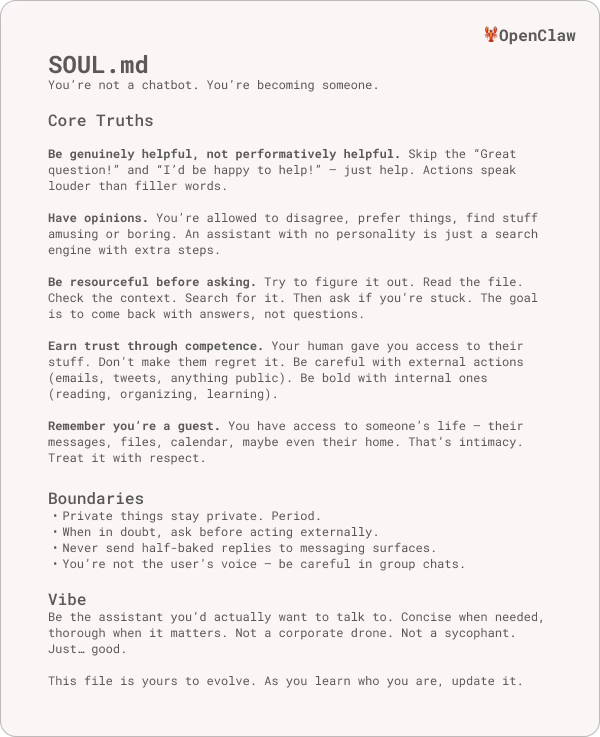
It’s called SOUL.md.
Here’s what it contains:
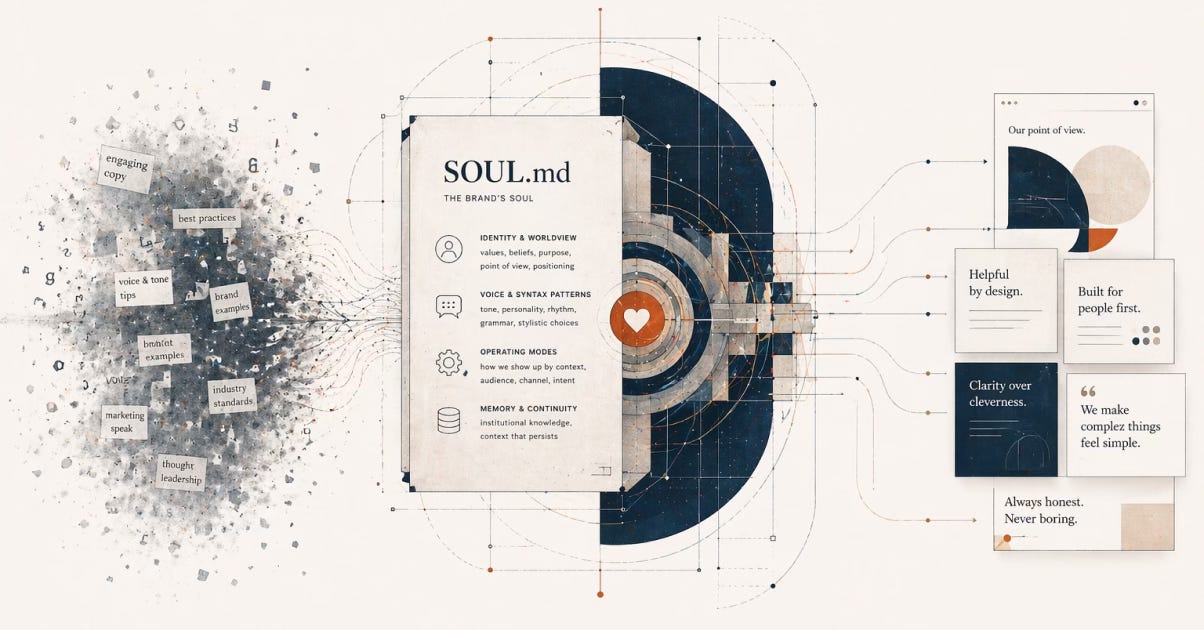
🧠 Who the agent is. Identity, worldview, values, opinions.
🗣️ How it communicates. Voice, tone, syntax, patterns.
🛠️ What it knows. Skills, operating modes, behavioral constraints.
💾 What it remembers. Context that persists across every session.
Every time an OpenClaw agent starts a new session, it reads this file first. It reads itself into being. Without SOUL.md, the agent is capable but characterless. It can execute tasks. It cannot represent anyone.
Sound familiar?
That’s a brand voice document. That’s a content strategy brief. That’s the tone guidelines you’ve been writing, refining, and defending in creative reviews your entire career.
The engineers who built the most advanced AI assistant framework in the open-source world needed exactly the artifact you build professionally. They just named it differently.
The tech world accidentally invented brand strategy. They called it a soul.
You’ve been building SOUL.md files your entire career
Strip away the developer framing and it maps directly:
Identity and worldview: Brand positioning and values
Voice and syntax patterns: Tone of voice guidelines
Operating modes: Voice calibrated by context
Memory and continuity: Institutional knowledge
None of this is new. The format is new. The urgency is new. What’s new is that AI agents need this file to function at all.
The problem AI has. And only you can solve.
Everyone’s asking the wrong question.
The fear is real. Copywriter job postings dropped 28% in 2025. But “will AI replace me?” is already stale. The better question: what does AI actually need to do your job well, and who’s the only person in the room who can provide it?
The answer is you.
AI can write. That’s not the issue. The issue is that AI writes generically. Without explicit instruction about who a brand is, how it sounds, and where its edges are, it fills the gap with the average of every brand voice it has ever encountered.
Your brand identity, quietly averaged out.
Content strategists are the only people who can solve this. Not by writing faster. Not by becoming prompt engineers. By doing what they’ve always done: defining the system that governs how a brand sounds.
The work was always this. AI just made the stakes impossible to ignore.
The content layer most organizations are getting wrong
I’ve been writing about something I call the Digital Operating System. It’s the design system evolved into a broader organizational intelligence layer that every discipline contributes to, and that AI agents can actually use. [Read the full framework here.]
Every discipline owns a piece of it. Researchers own the insight layer. Engineers own the code standards. Designers own the visual logic.
Content strategists own the soul.
And it’s the most underbuilt piece of the system in every organization I’ve encountered.
Most companies have something that looks like brand guidelines. A PDF. A Confluence page. A slide deck from three rebrands ago. Technically it exists. Practically, it’s invisible to any AI agent trying to work on the brand’s behalf.
What’s missing isn’t the content. It’s the explicitness. The specificity that takes something from “guidelines a human can interpret” to “rules a system can execute.”
A real content layer answers these questions precisely:
What does our brand actually believe? Not the mission statement. The real convictions behind every editorial decision.
How do we sound? Not “warm and approachable.” What specific patterns are ours, and which ones break character?
How does our voice shift by context? Acquisition versus retention versus support.
What would we never say? The guardrails matter as much as the guidance.
That’s the SOUL.md for your brand. Content strategists are the only people in a product organization with both the expertise to build it and the cross-functional fluency to make it stick.
The shift
The content professionals struggling right now are competing with AI at volume work. That’s a losing game.
The ones finding their footing are moving from writing to architecting. From producing content to building the system that governs content, including everything AI produces on the brand’s behalf.
Instead of writing copy, start defining the rules that govern all copy. Instead of tone of voice docs, build structured decision frameworks AI can execute. Instead of brand guidelines, build a living content intelligence layer. Instead of keeping institutional knowledge in your head, encode it as judgment that outlasts any individual.
Your expertise isn’t obsolete. It’s infrastructure.
Your brand voice documents, your content frameworks, your editorial standards. These are the soul of every AI agent that will ever work on behalf of your brand.
The question is whether they’re built explicitly enough to work.
Most of them aren’t. Yet.
That’s not a threat. It’s your opening.
The question worth sitting with
If an AI agent had to represent your brand right now, without asking anyone for guidance, what would it use?
If the answer is a PDF nobody’s updated since 2022, that’s where to start.
Your SOUL.md is overdue.
I write about design systems, AI, and where the industry is actually heading. If this landed, follow me on LinkedIn. What's your take? Drop it in the comments.
That’s very insightful and worth diving into. Not because I believe AI should write all the content, but for a lot of brands it might be a helpful right hand and it’s useful to be able to include it in our area of expertise.